background image

Navigating the viability gap: How data can empower housebuilders in today’s challenging UK market

Key takeaways

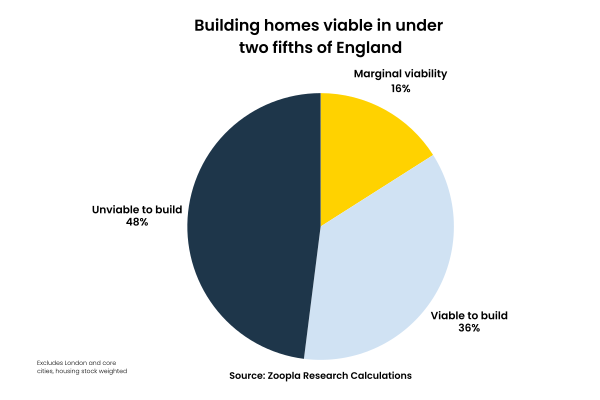
  • Recent research produced by Zoopla with the support of Hometrack reveals a “viability gap” stalling housing delivery. Building new homes is now economically unviable across nearly half of England (48%), with viability challenges present in almost two-thirds (64%) of the country.
  • Since 2022, housebuilders have had to deal with delivery costs soaring by an average of 17%. Over the same period, achievable sales prices have stagnated, rising by just 1% – a combination that has diminished investment confidence and halted development.
  • A paradox has emerged, in which regions where it remains financially viable to build typically face buyer affordability constraints. Conversely, in more affordable regions, the economics of development often don’t stack up, making it unviable to build.
  • While awaiting essential long-term policy reform, the industry must leverage granular, real-time data to de-risk projects, identify hidden opportunities, and build with confidence.
  • Housing association BPHA recently used data analytics to explore the viability of a regeneration project in Bedford town. They were able to test a target sales value by benchmarking proposed values and exploring the optimal housing mix.
background image

What’s holding back housing delivery?

Industry figures cast serious doubt on the UK government’s ambition to build 1.5 million new homes. Annual private housing starts in England have plummeted by 40% since the start of 2022, with planning approvals down by a quarter over the same period. This is not a cyclical downturn but a structural crisis, defined by what Zoopla’s latest report terms the “viability gap”.

This gap represents the divergence between the soaring cost of delivering new homes and the static sales values achievable in the current market. Since 2022, the average cost of building a new home has jumped by 17%, while average selling prices have risen by just 1%. This squeeze on margins has stalled projects and is hindering future housing supply. Historically, the housebuilding model relied on house price inflation to absorb rising costs, but this is no longer the case. The Zoopla report warns that house price inflation “cannot be relied upon to resolve the viability challenge,” forcing a shift away from speculative building towards a more evidence-based, de-risked approach where every decision is underpinned by robust data.

The disparity between build costs and sales values

While material and labour costs are significant contributors to the pressures facing developers, a growing financial burden comes from policy and regulatory requirements, such as Biodiversity Net Gain (BNG) and the forthcoming Building Safety Levy. These national regulations impose a relatively fixed cost per unit, regardless of the final sales value. This has a disproportionate impact across the country, penalising development in lower-value regions and deepening the North-South viability divide.

The North-South divide

Geographical market variations have created an “affordability paradox”. In Southern England, where sales values are highest, development is considered viable across two-thirds (64%) of the region. This figure drops to just 13% in the Midlands and 10% in Northern regions. However, in the viable Southern markets, high house prices are often above what most local workers can afford to buy. Conversely, in the most affordable markets in the North and Midlands, a staggering 90% of these areas are unviable for new housing development due to low sales values relative to build costs. This creates a lose-lose scenario where housing delivery is constrained by affordability limits in the South and by economic unviability in the North.

The following table, using data from the Zoopla report, illustrates the above:

Local authority Annual housing target Sales price relative to cost of development Viability status
St Albans 1,660 +50% Viable
Buckinghamshire 4,319 +30% Viable
Cornwall 4,421 +5% Marginal
Cheshire East 2,461 0% Marginal
Birmingham 4,448 -6% Unviable
Manchester 2,430 -7% Unviable
Kirklees 1,840 -26% Unviable
County Durham 2,011 -72% Unviable


A challenging demand landscape

Compounding the cost pressures facing housebuilders is a tougher demand backdrop. The end of the Help to Buy scheme in 2022, combined with higher mortgage rates, has eroded the purchasing power of potential buyers. This crisis extends to the affordable housing sector, where housing associations (HAs) are also facing financial pressures. HAs have historically de-risked projects for developers by acquiring the affordable housing portion of a scheme (via Section 106 agreements), but their weakened capacity has created uncertainty. Analysis shows that more than 100,000 private homes and 17,000 affordable homes are currently stalled due to a lack of bids for these Section 106 units.

Using data to build with greater confidence

The findings from Zoopla’s report are stark and lay bare the realities facing the housebuilding sector. While Hometrack supports the call for long-term policy reform, the industry cannot afford to stand still.

In an environment where macro-level viability is challenged, success now depends on identifying “micro-viability.” This requires a shift from high-level regional or even national data towards a granular, site-specific analytical methodology that can uncover opportunities and mitigate risk.

Case Study: BPHA leverages data to test regeneration viability

A recent project with housing association BPHA demonstrates this data-led approach. BPHA needed to assess the feasibility of regenerating three 1960s tower blocks in Bedford and test a target sales value in an uncertain market. By leveraging Hometrack’s Data Services, BPHA built an evidence base that gave them the confidence to understand the project’s viability and potential funding gaps.

  • Benchmarking and validation: The data confirmed that BPHA’s proposed values were “achievable,” benchmarking them against local and regional markets and identifying an affordability advantage compared to nearby Cambridge and Oxford.
  • Optimising the housing mix: The analysis revealed that achieved sale prices for local new two-bedroom flats were up to 22% higher than developers’ initial pricing, proving that local market demand for larger apartments was being significantly underestimated. This insight revealed an opportunity to adjust the housing mix and maximise overall sales values.
  • Competitive landscaping: Detailed insights into the active local development pipeline allowed BPHA to contextualise future competition.

The path forward

The viability gap presents a considerable challenge to the UK housing sector, threatening to deepen the housing shortage. While the industry clearly needs policy reforms, integrating data-driven analysis into decision-making processes can empower housebuilders with greater confidence.

Access to comprehensive data allows developers to move beyond anecdotal evidence, improving their ability to quantify market opportunities, evaluate investment risk, and make informed decisions on tenure mix, pricing, and value creation. Ultimately, it helps replace uncertainty with clarity, contributing to the delivery of the homes the UK desperately needs.

The developers best positioned to succeed during the wait for policy reform (and after) will be those who best use data to navigate the complexities of local markets.

Related Content
Housing Market Intelligence
background image

Benchmarking Local Market Performance: Why Developers Should Track Competitor Activity

Understand the power of local market performance benchmarking for developers. Learn how tracking competitor activity helps refine pricing, unit mix, and strategy in 2025.

Housing Market Intelligence
background image

Housing Market Intelligence: How It Improves Site Appraisal Decisions

Learn how site appraisal with housing market intelligence helps developers make smarter land bids, forecast demand, and optimise pricing strategy before a single brick is laid.

Comparables
background image

Development Launch Timing: Using Historical Market Data for Perfect Market Entry

Want to know how to determine perfect market entry for property developments? Learn how historical housing data can guide timing decisions, optimise pricing, and improve ROI.